What’s It Like to be Black at HPU

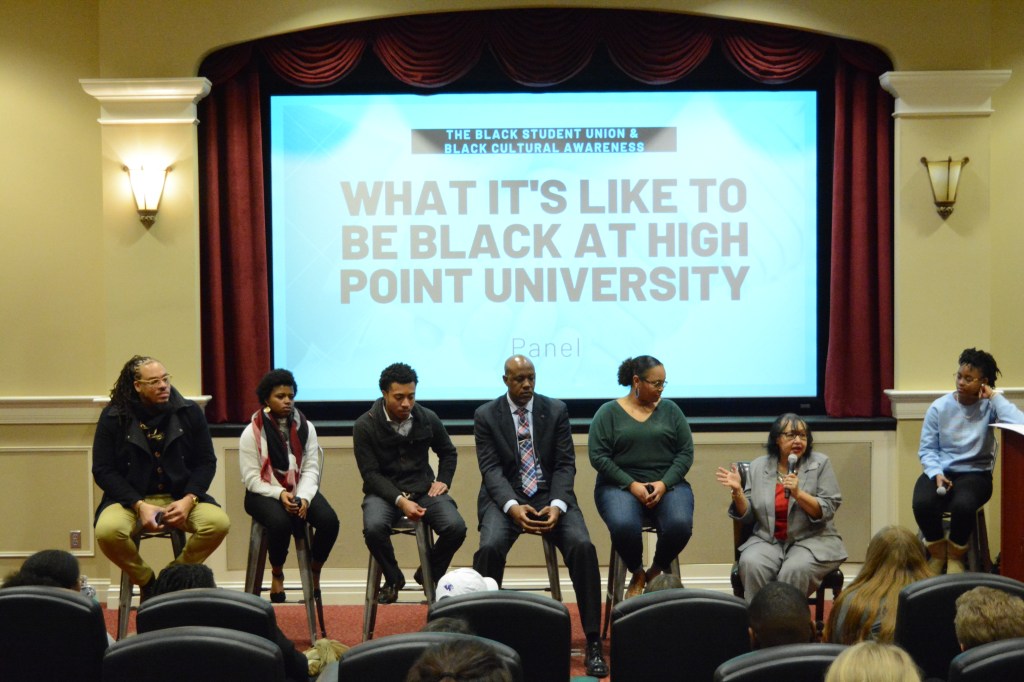
I attended, hosted, and planned “What’s It Like to be Black at HPU,” a documentary and panel. This documentary was filmed by myself and Kennedy Jackson, and edited by Kiara Johnson, representing the Black Student Union and Black Cultural Awareness. I developed questions to asks several panelists and moderated the questions amongst them and the audience members. The documentary and panel included students, faculty, and staff of High Point University. We asked students and faculty/staff several questions to get their experience and opinion of being Black at HPU. Questions included: “In one word, what is it like to be Black at HPU?” “What was your childhood like when it came to understand your race? How has that developed over time at HPU?” “What do you want non-Black students/faculty/staff to know about the Black experience?”

In planning the event, what happened on Thursday exceeded my expectations by a mile. I did not think that many people would come and be so engaged. The people that were present were from different departments, majors, classifications, genders, and genders. The conversation generated was productive and gave people an opportunity to be heard on a campus that is so set on silencing the truth. I loved listening to the panel and the answers they gave. I loved the responses they gave to questions and the fact that they made you think. Two of my favorite responses came from Douglas McCollum when he talked about when allies want to be allies and not intrude, he said “it’s okay to be uncomfortable.” And I think that is the preface to a lot of conversations. When you are trying to help a marginalized community that you are not part of, you will be uncomfortable because in that moment you are considered privilege. I also loved that Professor Drumwright said that he hoped white people in the crowd were “allies and not spies.” That was super important because that space was meant for the Black community on campus, and while I wanted non-Blacks to be there to learn and listen, they were not there to invade our space or try to take it away from us, and that was done perfectly.

“What’s It Like to be Black at HPU” was the opposing response to a single story. Single stories are dangerous. The single story of white students; the single story of a Black man; the single story of white faculty; the single story of a straight woman. This panel and documentary not only brought awareness to the Black community and our experience on campus, but also demonstrated that while we have similar experiences, we are very much different in a lot of things. One Black person does not speak for the entire population. This event made the fact that a single story is dangerous be true. Also, this event was put together by Black women. Not men or white women, but Black women. That’s representation. And representation has been a huge piece of this course.

The big takeaway from this event is power. Strength. Hope. Joy. I find all of these things in knowing that we do have allies on this campus– faculty and students. I know that there are Black faculty/staff that want to see myself and other Black students succeed, even if it means just listening. I am hopeful that administration will take their experience and our voices, and better High Point University. I love that our Black community could come together and fellowship and have a conversation that was overdue. I will remember how this event made me feel. Proud. I did a lot of this panel and logistics of the documentary by myself. I know that I have power and so does my voice. I was able to bring all of those people together and that means the world to me. Because not only am I more confident, but I have faith that the Black community on campus can only grow stronger and get better from this point forward.
Systemic Oppression Produces Literature

Kayla Quick

GBS 3298

Tuesday, March 3, 2020

Systemic Oppression Produces Literature

The restrictions and obstacles resulting from patriarchy create a unique experience that women have within producing literature. The novel, essays, videos, and events from this semester in “Women Writing Worldwide” come from a place of experienced oppression. Using the alleged “makings of a female” in Jamaica Kincaid’s “Girl,” the choices and definitions of an Indian woman in “The World Before Her,” Ijeoma’s coming-of-age story in Under the Udala Trees, and intersectionality within Kimberle Crenshaw’s “Mapping the Margins,” the presence of systemic oppression throughout women’s literature will be analyzed regarding the institutional structures of religion, family, and government, and the concepts of accessibility and internalization.

Jamaica Kincaid writes “Girl” in an overwhelming tone, which indicates the overwhelming nature of oppression by the family structure, and internalization of systemic oppression. It is naïve to think that patriarchy is not pertinent enough that women do not participate in their own oppression. On page 320, the mother says, “…this is how you smile to someone you don’t like very much…” While this seems like a simple task, men are known to tell women to “smile,” therefore the mother participates in patriarchy because she is telling her daughter to do something that men often tell women for their own personal desires. Within “Girl,” the mother has internalized the idea of what it means to be female and passes it down to her daughter, without thinking twice. The generational transfer of the acceptance patriarchy is exemplified when the mother says “…this is how you behave in the presence of men who don’t know you very well, and this way they won’t recognize immediately the slut I have warned you against becoming…” (321). Part of systemic oppression is the historical antecedents which have created and sustained it, which are manifested throughout Kincaid’s short story with the mother’s advice.

Nisha Pahuja’s documentary “The World Before Her,” depicts government, religion, and family as means of systemic oppression and examples of how that oppression is internalized. It was listed in the documentary that India has a record of about 750,000 girls aborted every year, and the number of girls killed at birth is unknown. The Indian government (and those for the patriarchy) being able to prefer males and get rid of the expected girls, is the most undeniable form of systemic oppression. In the documentary, traditional Indian culture and modern Indian advancements are put against each other. Religion, Hinduism within this documentary, stands as an oppressive force with its patriarchal values regarding marriage and careers. Throughout the documentary Prachi is ready to die by, and for, her religion, but also acknowledging the parts of it that she does not want to follow, like marriage and children. Prachi’s father believes, “a woman is complete only after giving birth.” Indian tradition becomes oppressive through family because Prachi’s father does not care about her preferences but insists she must follow what has always been done. Later in the documentary, Prachi is told “you’re fighting for a belief system that is actually controlling you,” and she stated that she knew that. Along with this acknowledgement, Prachi says “… he never hits me for things that are not wrong by me,” talking about her father. Prachi demonstrated her internalization of oppression when she thinks she deserves punishment because of her own mistakes. However, there is a certain liberation that Prachi has by being able to choose to fight for her country and religion even if others do not think it is right.

 In Under the Udala Trees, Ijeoma is confronted with the intersectionality of her race, sexual orientation, and religion. Systemic oppression is presented through religion and family within this novel. The church is a pivotal part of the Black community and often the Black identity, regardless of the country. The irony behind religion being instrumental for the Black community is that religion is another form of oppression because it was used to manage slaves. Throughout Ijeoma’s life in the novel, she is constantly dealing with the beliefs of the Black church. On pages 88 and 89 of Under the Udala Trees, Ijeoma’s mother tries to “pray the gay out of her,” which is oppressive because even though that is what Ijeoma’s mother was taught, at some point, liking the other sex was considered wrong by a person with intention to oppress. The use of religion in Under the Udala Trees hindered Ijeoma from being happy and free. On pages 124 and 125, Ijeoma and Amina were caught together. During this scene, the grammar school’s teacher’s husband pointed at the Bible and yelled “an abomination!” The Bible is used to shame a young girl about her sexuality, but not Christians for owning, selling, and harming people for hundreds of years. In contrast with internalizing systemic oppression, Ijeoma knew who she was and did not feel bad about it. Eventually, Ijeoma embraced who she was because she felt that God would still love her.

In “Mapping the Margins,” Kimberle Crenshaw discusses the systemic oppression of women through language barriers and race, which affect accessibility to resources. On page 204, Crenshaw writes “Despite this woman’s desperate need, she was unable to receive the protection afforded English speaking women, due to the shelter’s rigid commitment to exclusionary policies.” When someone is not able to get assistance based on part of their identity, which reinforces their identity as a minority, and policies, it is systemic because there is something in place which discriminates and hurts an already marginalized group of people. Intersectionality is the idea of having more than one identity, which ultimately results in one being more oppressed. “The need to split one’s political energies between two sometimes opposing groups is a dimension of intersectional difference than men of color and white women seldom confront.” (202). Intersectionality is a channel for systemic oppression built within the institutional structures of society.

Systemic oppression is an overall pattern for the materials that have been covered within this course. Being a woman in this world is an automatic enrollment in systemic oppression because males are seen and treated as the dominant sex. A positive result of systemic oppression is the creation of literature, documentaries, or art that is produced by those who have a voice and a unique experience. What role does every individual play in systemic oppression? How often is experienced oppression discussed within men’s literature? Are things oppressive if it is the choice of the woman? Where is the line drawn between oppressive and liberating? What would be considered fighting systemic oppression? What are some other forms of systemic oppression? A thinking point for systemic oppression is the common acceptance and not everyone questions it.

Ayasel Slay “Girl from Mecca”

This week on Twitter 🙂 In Saudi Arabia, a female rapper is facing arrest for being a female rapper. Most, if not all, female rappers are rapping about women’s empowerment whether it be explicitly stated or even if it’s talking about sex and the right for women to have pleasure. I thought this was relatable to class because we are studying women’s literature worldwide, not just America (which also includes African American women). I wanted to try to find a new topic for my posts instead of just Black women (even though Ayasel could still be Black), and in different countries. This shows how hypocritical government is, but also how controversial speaking up in whatever manner you choose, is too.

Renegade Creator

Over the past week, “Black Twitter” discovered that the Tik Tok dance to the song “Renegade” by rapper K Camp was created by a young Black girl and not the white girls who got famous off of it. The original dance had been modified to match the abilities of the white girls. After Jailah had gotten her recognition, the white girls who got famous off of her dance made a video with her in it. I think this relates to class in the regard that most of my post thus far have. The stories of Black girls are often diminished by white girls and their “twist” on things. I think this is another example of “western” stories being on the front line and creating their own twist on the culture of those who do not look like them. While the video they all made together was cute, I saw it as nothing more than the white girls trying to save themselves from stealing a dance and appropriating Black culture but white washing it.

Poetry Cafe at High Point University

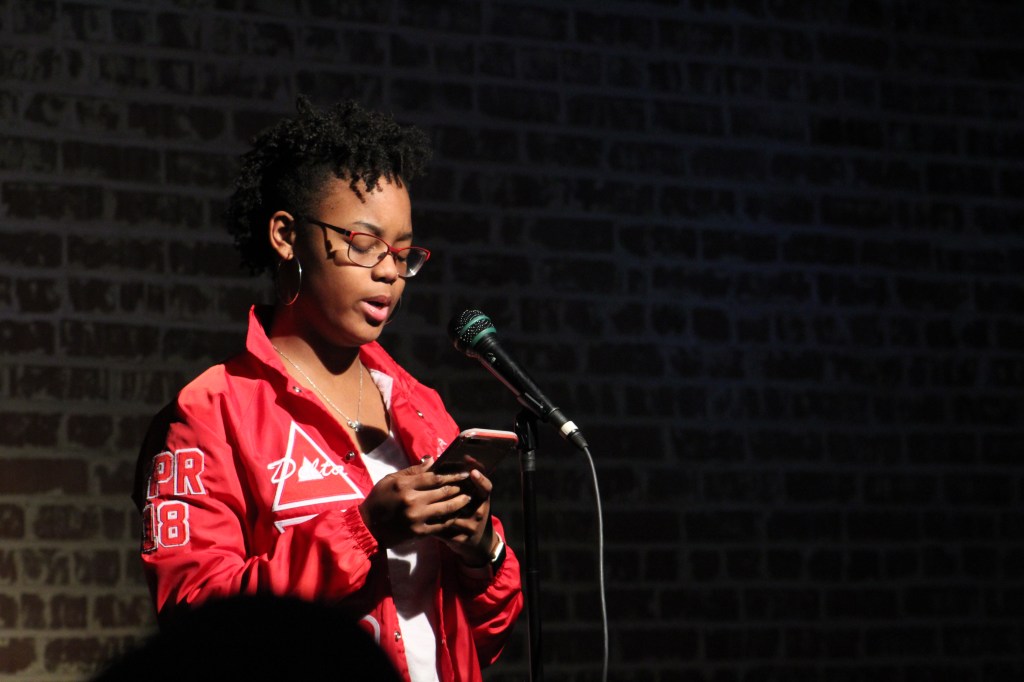
I attended the Poetry Cafe on February 11th, as a part of Black History Month and African Heritage Week with the Multicultural Affairs Office. Poetry Cafe is exactly what the description says, “an interactive open mic.” Artists of all kind performed, poetry, songs, etc. This is my second time attending Poetry Cafe at HPU, and I regularly attend the College Night Open Mic, which is hosted by the same group of people as Poetry Cafe. What I love so much about the Poetry Cafe is the vibe of the room and the installation of Black culture within the event. The hosts sing songs that are known in the Black community, which causes the crowd to sing along, and they talk back. No matter how many or few people attend an event like the Poetry Cafe, it is still very intimate. I love listening to poetry, especially poets who compete and utilized the Poetry Cafe as a place to practice. The stage is inviting and a safe place.

I performed at the Poetry Cafe. The poem I decided to read “Black is the Woman,” which is speaking to Black boys and Black men about the protection of the Black woman. The piece dives into the fact that Black women are hurt by Black men, while also being oppressed by white women and men. This poem relates back to the course because it is about the lives and story of Black women and accountability. Black women deserve to be protected and are the most marginalized group in America. This class prompts me to add the “in America” because we have been learning about other cultures and countries, but nonetheless, Black women have stories and literature that should also be discussed and read in classrooms.

I work closely with Douglas McCollum, the man responsible for Poetry Cafe coming to High Point University, in many regards. Naturally, I attend Poetry Cafe as a means of support. But I also attend to receive great energy and have a place to release my emotions and my poems where people (who probably get uncomfortable) have to sit and listen to them and think about it. Events like the Poetry Cafe are fun and great to attend, but I think by having it count as an event for class enhances its ability to be an educational tool in regards to self-love, poetry, different experiences, tough conversations, and Black culture, which are all necessary for the world we’re living in.

Here is my poem (if you’re interested):

Black is the Woman


Dear Black Boy and Black Man,

What does it mean to build a world in which Black women and Black girls are safe?

Black women are the only group of people whose bodies have ever been legally mandated as the place that reproduced noncitizens.

At least 60,000 Black women are missing right now. Your mothers, your daughters, aunts, cousins, nieces, significant others, friends.

The system continues to fail us, but so do OUR men.

In 2014, more than 200 Black school girls were kidnapped, raped, and forcefully impregnated by Black men. #BringBackOurGirls.

In the 2nd decade of the 21st century, 8 Black women a week are murdered by a Black man they know.

yet again, another force meant to protect me is whom I fear.

Any of these things could happen to me JUST because I am a Black woman.

I have to worry about the white man, the white woman, and now, the Black men. My father, brothers, uncles, cousins, nephews, significant others, friends.

Dear Black Boy and Black Man,

I love y’all. Admittedly, sometimes more than I love my fellow Black women. Sometimes.

But, Black men, y’all scare the shit out of me.

And not because of your race.

And not because I’ve been hurt before.

But because you are still man.

And I don’t know what men like you may do to women like me. But I know what you could do.

Toxic Masculinity Kills.

Patriarchy.

Black women are unprotected. Invalid. Too opinionated. Bitches. Attitude givers. Loudmouthed. Too independent. Aggressive. “Nappyheaded.”

But don’t forget these are the same Black women that clothed you, birthed you, loved you, protected you. Stood up for you. Literally dying for you.

Nevermind that Kodak Black was accused of rape. But we still listening. But, he disrespected another Black man’s “woman,” and now he’s cancelled.

Dear Black Boy and Black Man,

I know you’re only a product of your environment.

I know the whole world is against you because of the color of your skin.

I know its hard for you to show emotion because the world doesn’t see you as anything other than a monster.

But I hope you know, this Black woman here is a product of her environment, battling the world for her skin and her gender. I can’t show emotion either.

I’m not saying Black women have it harder than Black men. But if you wanna argue, I’m down.

I’m saying, Black women deserve better. We deserve protection. Loyalty. Safety.

We deserve the same love, joy, and patience we give y’all.

Dear Black Boys and Black Men,

What does it mean to build a world in which Black women and Black girls are safe?

I’m only asking you because y’all have the power to hold us down. Or hold us back.

White Women’s Role in White Supremacy

I saw this comment posted under an Instagram post where someone was venting about not being able to express their emotions on being Black to white people, especially white women. I felt this comment was relevant to this course because it talks about accountability for white women in their role in white supremacy which is necessary when discussing [true] feminism. We are reading about experiences of women of color and women who do not fall into the category of “straight, white, and woman,” which is a part of accountability in a system of oppression– understanding other stories.

What A Relief…

This class is about women’s writing worldwide. Poetry is a form of writing and expression. Reyna Biddy is one of my favorite poets, and hearing her read her poems is phenomenal. I chose this poem because she is speaking on women’s experiences and everything we go through and her own emotions because of it. It is relevant to the class because I think this is relatable for every woman, no matter what makes her different.

Design a site like this with WordPress.com
Get started