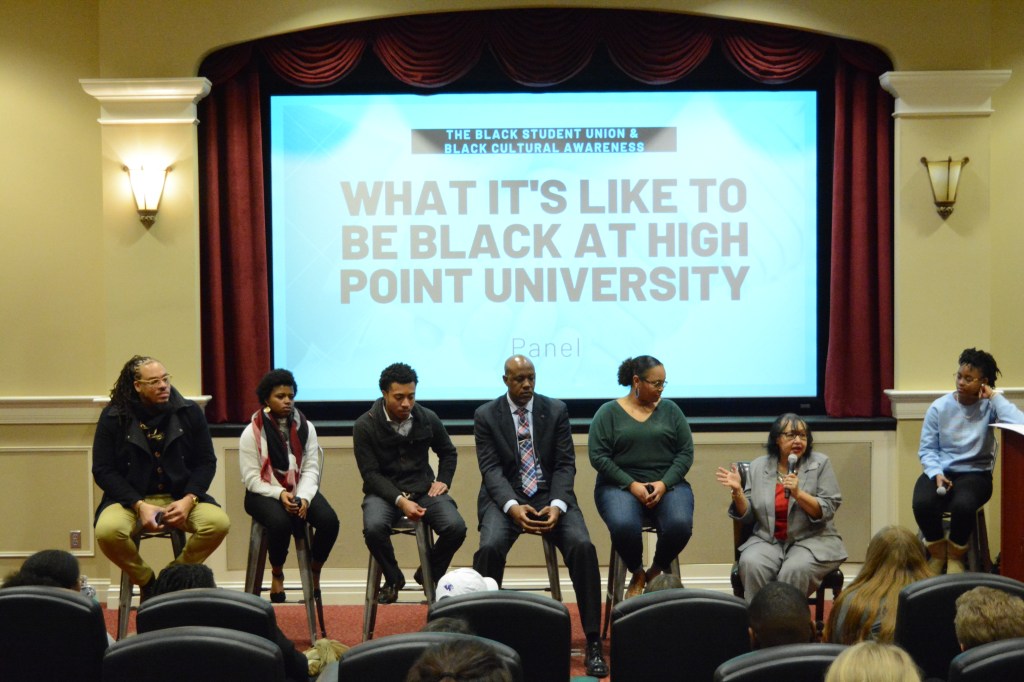
I attended, hosted, and planned “What’s It Like to be Black at HPU,” a documentary and panel. This documentary was filmed by myself and Kennedy Jackson, and edited by Kiara Johnson, representing the Black Student Union and Black Cultural Awareness. I developed questions to asks several panelists and moderated the questions amongst them and the audience members. The documentary and panel included students, faculty, and staff of High Point University. We asked students and faculty/staff several questions to get their experience and opinion of being Black at HPU. Questions included: “In one word, what is it like to be Black at HPU?” “What was your childhood like when it came to understand your race? How has that developed over time at HPU?” “What do you want non-Black students/faculty/staff to know about the Black experience?”
In planning the event, what happened on Thursday exceeded my expectations by a mile. I did not think that many people would come and be so engaged. The people that were present were from different departments, majors, classifications, genders, and genders. The conversation generated was productive and gave people an opportunity to be heard on a campus that is so set on silencing the truth. I loved listening to the panel and the answers they gave. I loved the responses they gave to questions and the fact that they made you think. Two of my favorite responses came from Douglas McCollum when he talked about when allies want to be allies and not intrude, he said “it’s okay to be uncomfortable.” And I think that is the preface to a lot of conversations. When you are trying to help a marginalized community that you are not part of, you will be uncomfortable because in that moment you are considered privilege. I also loved that Professor Drumwright said that he hoped white people in the crowd were “allies and not spies.” That was super important because that space was meant for the Black community on campus, and while I wanted non-Blacks to be there to learn and listen, they were not there to invade our space or try to take it away from us, and that was done perfectly.
“What’s It Like to be Black at HPU” was the opposing response to a single story. Single stories are dangerous. The single story of white students; the single story of a Black man; the single story of white faculty; the single story of a straight woman. This panel and documentary not only brought awareness to the Black community and our experience on campus, but also demonstrated that while we have similar experiences, we are very much different in a lot of things. One Black person does not speak for the entire population. This event made the fact that a single story is dangerous be true. Also, this event was put together by Black women. Not men or white women, but Black women. That’s representation. And representation has been a huge piece of this course.
The big takeaway from this event is power. Strength. Hope. Joy. I find all of these things in knowing that we do have allies on this campus– faculty and students. I know that there are Black faculty/staff that want to see myself and other Black students succeed, even if it means just listening. I am hopeful that administration will take their experience and our voices, and better High Point University. I love that our Black community could come together and fellowship and have a conversation that was overdue. I will remember how this event made me feel. Proud. I did a lot of this panel and logistics of the documentary by myself. I know that I have power and so does my voice. I was able to bring all of those people together and that means the world to me. Because not only am I more confident, but I have faith that the Black community on campus can only grow stronger and get better from this point forward.
 Kayla Quick Women Writing Worldwide